

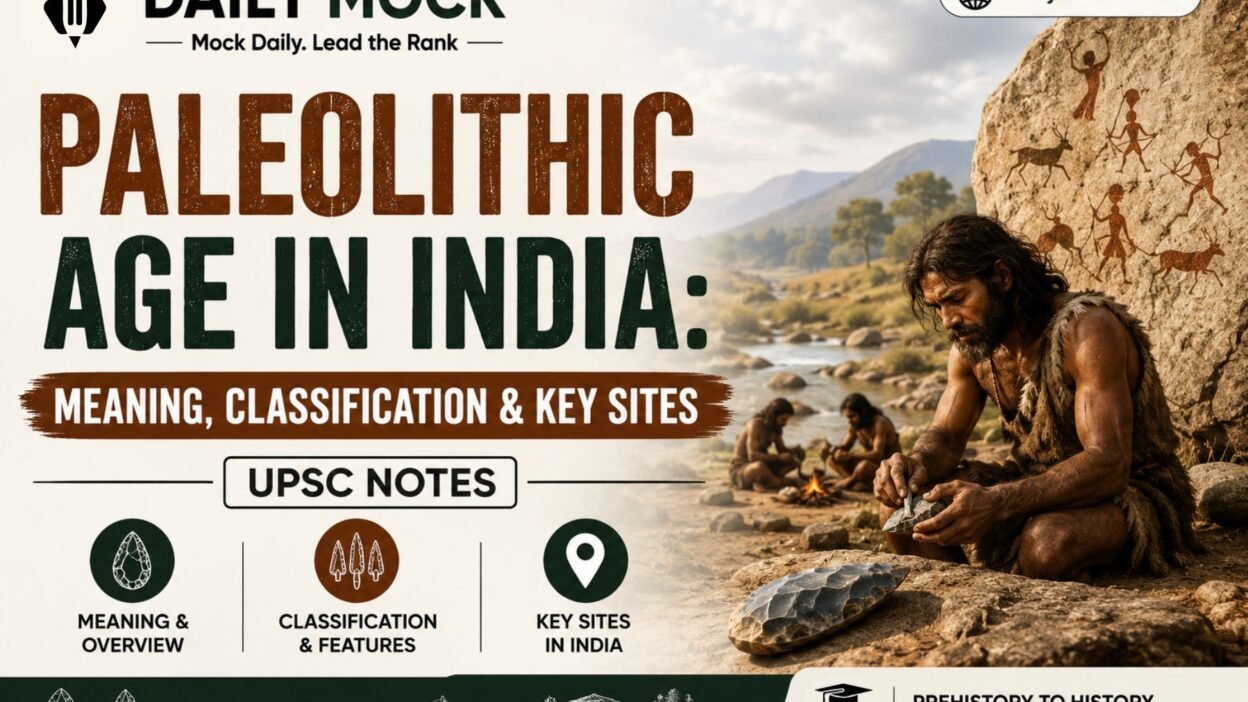
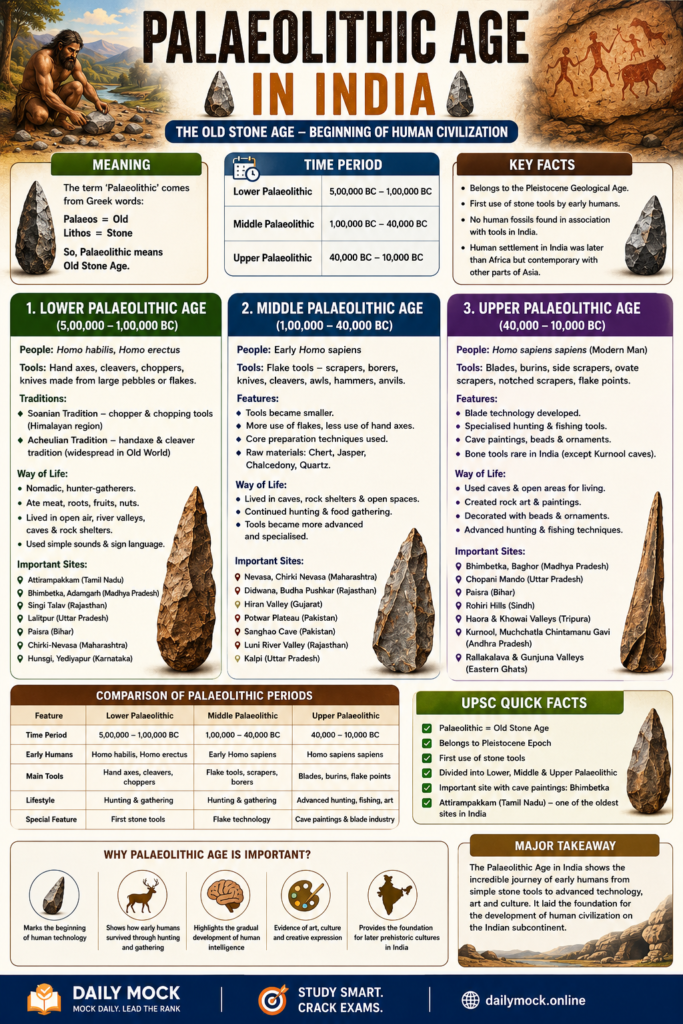
The Palaeolithic Age (Old Stone Age) marks the earliest period of human history within the Prehistoric Era, falling under the Pleistocene geological epoch.
- Etymology: Derived from Greek words palaeos (old) and lithos (stone).
- Key Feature: First appearance and development of stone tool technology.
- Indian Context: Human settlement in India began later than in Africa, but was contemporaneous with other Asian regions. Notably, no human fossils have been directly associated with Stone Age tools in India; dating relies primarily on geological context.
Classification of the Palaeolithic Age
The Palaeolithic Age in India is divided into three distinct phases based on tool technology, economic activities, and cultural evolution:
Palaeolithic Age
├── Lower Palaeolithic (500,000 – 100,000 BC)  ➔ Pebble & Chopper-Cleaver Tools
├── Middle Palaeolithic (100,000 – 40,000 BC)   ➔ Flake Tool Industry (Nevasian)
└── Upper Palaeolithic (40,000 – 10,000 BC)    ➔ Blade & Burin Industry / Cave Art
1. Lower Palaeolithic Age (500,000 – 100,000 BC)
- Human Species:Homo habilis and Homo erectus.
- Way of Life: Nomadic hunter-gatherers living in open air, river valleys, caves, and rock shelters. Lacked complex language; communicated via basic sounds and gestures.
- Tool Technology: Large pebbles or flakes used to craft choppers, hand axes, cleavers, and knives.
Two Major Tool Traditions
- Soanian Tradition: Part of the East/Southeast Asian chopper-chopping tool tradition.
- Acheulian Tradition: Characterized by bifacial hand axes and cleavers (common across Africa, Europe, and Asia).
Key Sites
- Madhya Pradesh: Bhimbetka, Adamgarh
- Rajasthan: Singi Talav (Didwana)
- Tamil Nadu: Attirampakkam, Gudiyam
- Other States: Chirki-Nevasa (Maharashtra), Hunsgi (Karnataka), Paisra (Bihar), Lalitpur (UP)
2. Middle Palaeolithic Age (100,000 – 40,000 BC)
- Human Species: Early Homo sapiens.
- Way of Life: Nomadic hunter-gatherers; marked by the emergence of early language, deliberate burial of the dead with rituals, and refined core-preparation techniques.
- Tool Technology: Widely called the Flake Tool Industry (or Nevasian culture in India). Tools became smaller and relied less on hand axes. Raw materials shifted to fine-grained stones like chert, jasper, chalcedony, and quartz.
Tool Types
- Scrapers (straight, concave, convex), borers, awls, small/medium hand axes, anvils, and hammers.
Key Sites
- Rajasthan: Didwana, Budha Pushkar, Luni River system
- Maharashtra: Chirki-Nevasa
- Uttar Pradesh: Kalpi
- Other Regions: Hiran Valley (Gujarat), Potwar Plateau & Sanghao Cave (Pakistan)
3. Upper Palaeolithic Age (40,000 – 10,000 BC)
- Human Species: Modern humans (Homo sapiens sapiens) emerging ~50,000 years ago during the Late Pleistocene.
- Way of Life: Cave and open-air dwellers; onset of cave art, personal ornaments (beads), and specialized hunting tools for big/small game and fishing.
- Tool Technology:Blade-and-Burin Industry alongside scrapers and flake points.
Key Highlights
- Art: Earliest green-colored rock paintings at Bhimbetka date to this period.
- Bone Tools: Rare in India, but prominently discovered at Kurnool Caves (Andhra Pradesh).
Key Sites
- Andhra Pradesh: Kurnool, Muchchatla Chintamanu Gavi, Rallakalava & Gunjana valleys
- Madhya Pradesh: Baghor
- Other States: Chopani Mando (Belan Valley, UP), Paisra (Bihar), Rohiri Hills (Sindh), Haora & Khowai Valleys (Tripura)
Quick Revision Summary for Prelims
| Phase | Time Period | Key Species | Core Tool Industry | Main Raw Materials |
| Lower Palaeolithic | 500,000 – 100,000 BC | Homo erectus / habilis | Handaxe, Cleaver, Chopper (Soanian & Acheulian) | Large quartzite pebbles |
| Middle Palaeolithic | 100,000 – 40,000 BC | Early Homo sapiens | Flake Tools (Scrapers, Borers, Nevasian) | Chert, Jasper, Chalcedony |
| Upper Palaeolithic | 40,000 – 10,000 BC | Homo sapiens sapiens | Blade & Burin, Bone Tools | Flint, fine stone blades |
Mock Daily — Lead the Rank
Practice daily topic-wise UPSC GS mock tests and revision notes atdailymock.online.